*

Freon leak source

Finding a leak in an air conditioning system can indeed range from straightforward to highly challenging, primarily depending on the size and location of the leak. Large leaks, such as those from a cracked pipe or a visibly broken component, can often be identified quickly through visual inspection or by noticing a significant drop in system performance. However, small leaks present a more complex challenge and require a meticulous approach for detection.

Challenges in Locating Small Leaks

  • Accessibility: Air conditioning systems consist of numerous components, including internal coils, external units, and extensive piping that may run through walls, ceilings, or floors. Not all parts are easily accessible for inspection, making it difficult to visually identify small leaks.
  • Size of the Leak: Small leaks, especially those that are microscopic in size, may not immediately impact the performance of the system in a noticeable way. They can, however, accumulate over time, leading to a significant loss of refrigerant and decreased efficiency.
  • Lack of Visible Signs: Unlike larger leaks, which may leave obvious signs such as pooling refrigerant or large amounts of oil residue, small leaks might not leave any visible trace. In the case you mentioned, the safety valve was identified as a leak source because the area around it was shiny, indicating an absence of oil residue which could have otherwise masked the leak.

Techniques for Detecting Small Leaks

  1. Electronic Leak Detectors: These are specialized tools that can sense refrigerant gases in the air. Technicians use them to scan areas where leaks are suspected, including welds, connections, and valves. These devices are highly sensitive and can detect very small leaks.
  2. Dye Tests: A fluorescent dye can be added to the refrigerant. Over time, this dye will escape through leaks and can be made visible under a UV light, revealing the location of the leak.
  3. Pressure and Vacuum Tests: By pressurizing the system with nitrogen or pulling a vacuum, technicians can determine if there is a leak based on pressure changes. This method can indicate the presence of a leak but might not precisely pinpoint its location without further investigation.
  4. Soap Bubble Test: For accessible areas, a soap solution can be applied to suspect points. Bubbles forming indicate escaping gas, thus pinpointing the leak. This method is more practical for larger leaks or leaks at accessible connection points.

Role of the Technician

Technicians must adopt a systematic approach, often starting with a visual inspection and followed by the use of specialized tools and techniques to detect and locate leaks. They must scrutinize all potential weak points, including welds, connections, and valves, where leaks are most likely to occur. The process can be time-consuming and requires patience, experience, and a thorough understanding of the air conditioning system’s operation and layout.

In the example you provided, the technician identified a safety valve as the leak source due to the shiny background indicating a clean area free of oil residue, which is often present around leak points. This observation points to the importance of experience and attention to detail in diagnosing and resolving issues within complex systems like air conditioning units.

*

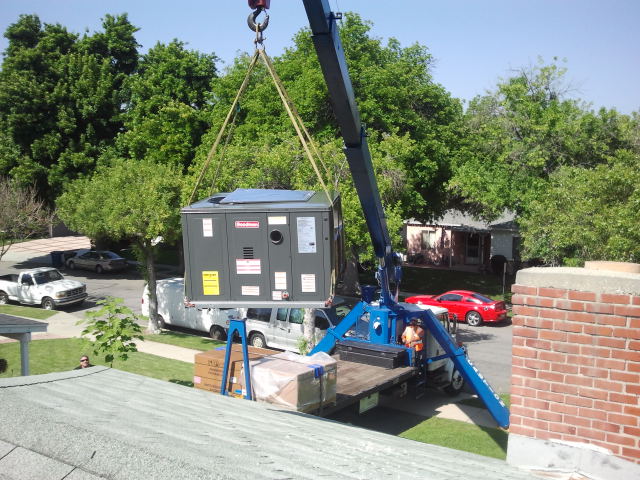
AC package unit installation

The process of installing an air conditioning (AC) package unit onto a rooftop involves several critical steps and considerations to ensure the unit is installed safely, efficiently, and effectively. The use of a crane to lift the unit onto the roof is a common practice, especially for large, commercial AC units that are too heavy to be manually lifted. Here’s a detailed look into this process:

Lifting the AC Package Unit

  • Preparation: Before lifting, technicians ensure that the AC package unit is properly secured and balanced for lifting. This often involves attaching slings or straps to designated points on the unit to ensure a stable lift.
  • Crane Use: A crane is carefully positioned and used to lift the AC unit from the ground to the rooftop. The crane’s capacity must exceed the weight of the AC unit to safely complete the lift. Crane operators and ground personnel communicate closely during this operation to ensure safety and precision.

Roof Curb Installation

  • Function of the Roof Curb: The roof curb serves multiple critical functions. It’s not just a platform; it’s a specially designed support structure that bears the weight of the AC unit, ensuring it is securely mounted on the roof. Additionally, the curb facilitates the integration of the AC unit with the building’s ductwork system.
  • Construction and Design: Typically made from galvanized sheet metal, roof curbs are designed to withstand the outdoor elements and the significant weight of the AC units they support. They are custom-fabricated to match the footprint of the AC unit, ensuring a proper fit.
  • Air Duct Penetration: The roof curb is engineered to provide a seamless transition for air ducts through the roof, allowing for efficient air flow from the AC unit into the building’s interior spaces. This is crucial for the “down shot” installation, where the air is distributed downward into the building.
  • Sealing and Insulation: Proper sealing and insulation around the roof curb are essential to prevent water leakage and to maintain energy efficiency. The curb is sealed to the roof to prevent water ingress, and the duct connections are insulated to prevent energy loss.

Installation Considerations

  • Weather and Environmental Factors: The installation process must consider weather conditions, as lifting operations can be hazardous in high winds or inclement weather. Additionally, the positioning of the AC unit and curb must account for water drainage and roof load-bearing capacity.
  • Compliance and Standards: The installation must comply with local building codes, regulations, and industry standards, ensuring that the unit is installed safely and operates efficiently.
  • Coordination with Roofing Contractors: Often, the installation of a roof curb requires coordination with roofing contractors to ensure the integrity of the roof is maintained and that the installation does not compromise the roof’s warranty or performance.
*

Ductless Mini split AC unit.

Mini-split air conditioning systems, also known as ductless mini-splits, have indeed become increasingly popular in both residential and commercial settings due to their efficiency, flexibility, and ease of installation. These systems offer a versatile solution for cooling (and often heating) individual rooms or zones within a building without the need for extensive ductwork. Let’s delve deeper into the two types of mini-split systems and their benefits, especially in comparison to standard central AC systems.

Single Zone Mini-Split Systems

  • Application: Single zone systems are designed to cool or heat a single room or area. This makes them an ideal choice for adding climate control to spaces like new additions, garages converted into living spaces, or rooms that have specific temperature needs separate from the rest of the building.
  • Components: A single zone system consists of one outdoor condensing unit connected to one indoor unit via refrigerant lines. The indoor unit is typically mounted on the wall but can also be ceiling-mounted or floor-standing, depending on the space and preference.
  • Efficiency: These systems are known for their high energy efficiency. They operate on less power because they’re designed to condition the air of a single room, avoiding the energy losses typically associated with ductwork.

Multi-Zone Mini-Split Systems

  • Application: Multi-zone systems are capable of cooling and heating multiple rooms or areas independently of each other. Each zone (or room) has its own indoor unit, which is connected to a single outdoor unit. This setup is perfect for houses or buildings where room-by-room temperature control is desired.
  • Components: Multi-zone systems consist of one outdoor unit that can support multiple indoor units. These indoor units can be a mix of wall-mounted, ceiling-mounted, or floor-standing types, depending on the requirements of each room.
  • Efficiency and Control: Multi-zone systems offer a highly efficient way to condition spaces because each zone can be controlled independently, allowing for precise temperature management without wasting energy on unoccupied rooms. This capability significantly enhances overall system efficiency and occupant comfort.

SEER Efficiency Rating

  • Higher SEER Ratings: Mini-split systems generally offer higher Seasonal Energy Efficiency Ratio (SEER) ratings than standard central air conditioning units. While central AC systems might max out at 14 to 16 SEER, many mini-split systems offer SEER ratings well above 20, making them significantly more energy-efficient.
  • Cost Savings: The higher the SEER rating, the more efficient the system is at converting electricity into cooling power. Over time, the energy savings from using a high-SEER mini-split system can offset the initial investment, making them a cost-effective solution for climate control.

Comparison with Central AC Units

  • Ductless vs. Ducted: One of the key differences between mini-splits and traditional central AC units is the absence of ductwork. Ductless mini-splits are more efficient in part because they eliminate the energy losses associated with ductwork, which can account for more than 30% of energy consumption, especially if the ducts are in unconditioned spaces like attics or crawl spaces.
  • Flexibility: Mini-splits offer greater flexibility in terms of installation and design. They can be installed in locations where it’s impractical or too expensive to extend or install new ductwork.
  • Installation: Installation of mini-split systems is generally quicker and less invasive than installing or extending ductwork for a central AC system, making mini-splits an attractive option for retrofitting older buildings with air conditioning.

In summary, mini-split air conditioning systems, whether single zone or multi-zone, provide a versatile, efficient, and cost-effective solution for cooling and heating spaces. Their high SEER ratings, along with the ability to control temperatures in individual zones, make them an increasingly popular choice over traditional central AC systems, especially in applications where flexibility and efficiency are paramount.